
The Desjardins Centre for Advanced Training helps research trainees find their path to impact
SOURCE: The Institute
November 5, 2025
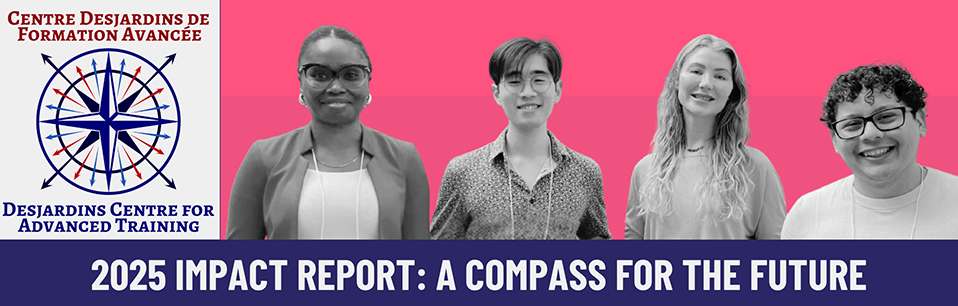
At the Research Institute of the McGill University Health Centre (The Institute), tomorrow's discoveries depend on the people we train today. The Desjardins Centre for Advanced Training (DCAT) embodies this belief, empowering research trainees to build meaningful careers across academia, industry, government, and beyond. The Centre's newly released 2024–2025 Impact Report, A Compass for the Future, highlights a year of national growth, innovation, and tangible results for the next generation of scientists.
"The Desjardins Centre for Advanced Training is a compass—not a map," says Emily Bell, PhD, Associate Director of DCAT. "We help trainees navigate uncertainty, explore opportunities and chart a path grounded in their own strengths and values."
Expanding reach and impact
Based at The Institute, DCAT supports more than 1,200 research trainees each year—the largest community of its kind in Quebec. Begun as a pioneering partnership between The Institute and Concordia University's John Molson School of Business, DCAT has since evolved into a national network engaging partners across the country. With foundational support from Desjardins and further support from the Fonds de recherche du Québec (FRQ) and the Canadian Institutes of Health Research (CIHR), DCAT is now a recognized leader in career and professional development for health research trainees across Canada
"DCAT has evolved beyond its original partnership, scaling an innovative model that links health research training with real-world skills," says Dr. Miguel Burnier, Director of DCAT. "Our programs now reach learners from 17 institutions across Canada—proof that our approach works."
Training designed for real-world health impact
Over the past year, DCAT continued to deliver an impressive range of programs, including a Clinical, Regulatory and Medical Affairs training stream, the Future in Focus: Precision Medicine Career Discovery Program, and one-on-one career advising that connects trainees to professional opportunities. In total, more than 900 trainees participated in over 50 learning activities, and $22,500 in awards were distributed to support the professional development of three trainees to complete the Life Sciences Entrepreneurship Development Program (a collaboration between the John Molson Executive Centre, Montreal InVivo, and Faculty of Pharmacy at the University of Montreal).
The report shows measurable results: 93% of trainees say DCAT programs complement their formal research training, and 86% report greater career confidence after participating. Workshops on transferable skills, networking, and job searching remain among the most sought-after activities.
Voices of leadership and alumni
In her foreword to the 2024-2025 annual impact report, Dr. Rhian M. Touyz, Executive Director and Chief Scientific Officer of The Institute, calls DCAT "a reflection of our mission—research and training that translate into tangible benefits for health and society." Alumni stories throughout the report illustrate that impact: graduates extend their impact at organizations such as the World Health Organization, BC Cancer, and biotech startups across Canada and beyond. Many have returned as mentors, guest speakers and program partners, closing the loop between training and leadership.
"Giving back to trainees allows me to contribute to that same collaborative culture and to help others navigate both the opportunities and challenges of research and entrepreneurship," says The Institute alumnus Rubén López, now CEO of Nanofacile, a biotech company redefining how RNA therapies are developed.
Looking ahead
With continued support from Desjardins, DCAT is poised to broaden its programs through new partnerships and multisite training initiatives in 2025–2026. As the impact report makes clear, the Centre remains a vital part of The Institute's vision to advance precision health and nurture the people who will lead it.
"We help research trainees find their way—not follow someone else's," says Emily Bell. "That's the heart of what we do."
Related News
DCAT's annual Impact Report, 2024-2025
"Career Spark" allows trainees at The Institute to explore diverse career paths
Advancing career growth at the RI-MUHC
A new grant to improve career development for graduate students
Desjardins' donation leads to development of unique centre to prepare research trainees