
How one Montreal neonatologist's side project to standardize his own lab's methods became a free teaching tool used in 216 countries
Source: The Institute
September 23, 2026
A baby born ten weeks early does not need a diagnosis of a structural heart defect to be in real danger. Often the heart itself is formed correctly, but the plumbing around it, the vessels feeding the lungs and the rest of the body, is not yet working the way it should. Pressure builds in the wrong places, and the heart does not fill the way it needs to. The infant looks unstable, and doctors have only minutes to figure out why.
At the Montreal Children's Hospital, neonatologist and scientist at the Research Institute of the MUHC (The Institute), Dr. Gabriel Altit answers that question using nothing more invasive than an ultrasound wand pressed against a newborn's chest. His specialty, targeted neonatal echocardiography and neonatal hemodynamics, is not about spotting malformed hearts. That job belongs to pediatric cardiologists.
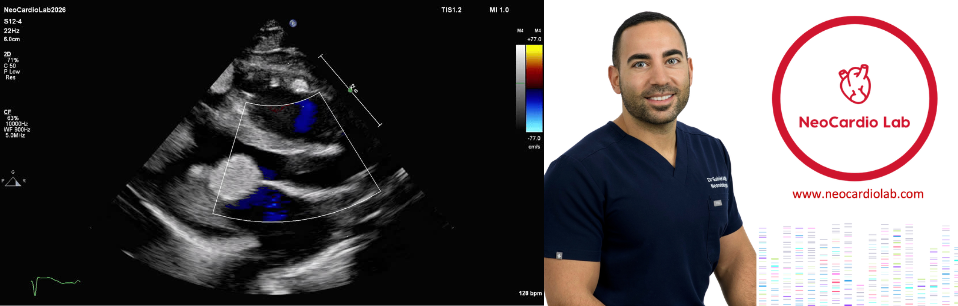
Instead, Dr. Altit reads the moment-to-moment behavior of a normally shaped heart: whether the lungs are under too much pressure, whether the heart is filling properly, whether a baby's instability has a treatable cardiovascular cause. Think of it less like inspecting a house's foundation and more like reading its water pressure gauge in real time.
It is a young field, recognized as its own specialty by the Royal College of Physicians and Surgeons of Canada only within the past decade, with McGill among the handful of accredited training programs. For years, Dr. Altit noticed a gap: no single place existed where clinicians could learn to standardize their imaging or find the evidence behind a treatment decision.
So he built one. What started as an internal tool to standardize methodology for his own research team, a project now called the NeoCardio Lab, has quietly grown into a global teaching platform, free on the web and through Android and Apple apps. It includes video clips walking learners through standardized ultrasound views, calculators for normative blood pressure and echo values, and medication guidance with references attached.
The reach caught even Dr. Altit off guard. Between 2022 and 2026 alone, the site logged more than 700,000 views and 241,000 users from 216 countries. The lab's YouTube channel, covering topics from basic cardiac measurements to neonatal hypertension, has drawn over 110,000 views and 11,000 hours of watch time from about 2,800 subscribers, sizable numbers for what Dr. Altit calls "a very niche field."
The lab has also opened up its research methods rather than keeping them behind a journal paywall. For advanced techniques like speckle tracking, a sophisticated way of measuring how well an infant's heart muscle contracts, the team posts step-by-step video modules so other centres can reproduce the process, not just read about it in a methods section. That openness has turned NeoCardio Lab into a trusted partner, with outside hospitals now asking it to serve as a central "core lab" analyzing their imaging data.
Dr. Altit and his team also validated the platform's impact in a peer-reviewed study published in Neonatology in July 2026, analyzing usage data alongside a survey of clinician users. The results found that 84% of surveyed users reported increased confidence in neonatal hemodynamics after using NeoCardioLab, with particular value noted for its modules on pulmonary hypertension, congenital heart disease, and congenital diaphragmatic hernia.
Dr. Altit describes the operation as a village: a project manager, a research coordinator, students and fellows, NICU nurses, imaging technologists, and pediatric cardiology colleagues, backed by funders including the Just for Kids Foundation, which bought the lab its first echo machine, along with the Pediatric Research Foundation, CIHR, FRQS, and the Montreal Children's Hospital Foundation.
He is candid about the challenges in the work, too. Every project touches families navigating a frightening NICU stay or a difficult pregnancy, so while the science is critical, so too is sensitivity toward patients and families. Parent partners now help shape how studies are designed and run, a human sensitivity Dr. Altit says no algorithm can replace.
What began as a way to keep one lab's own measurements consistent has become a shared library for an entire international specialty, built one video and one dataset at a time.
Altit G. NeoCardioLab: A Digital Platform for Neonatal Hemodynamics Education. Neonatology. 2026 Jul 9:1-11. doi: 10.1159/000553491. Epub ahead of print. PMID: 42424234; PMCID: PMC13461112