
Researchers uncover how the proteins Spire and Rab11 work together to trigger new branches in neurons, revealing a key mechanism in how the brain's wiring takes shape
SOURCE: The Institute
November 13, 2025
For the brain to function properly, neurons must form complex networks by establishing precise connections, or synapses, with the dendrites of other neurons. The patterns of dendritic branching determine how each neuron receives and integrates information. Because this branching is essential for neural communication, disruptions in the process are linked to developmental and neurodegenerative diseases. Yet, how new dendritic branches form in the right place at the right time has remained unclear.
A new study published in Development by scientists at the Research Institute of the McGill University Health Centre (The Institute) has revealed an important piece of that puzzle: two proteins, Spire and Rab11, work together to spark the growth of new dendritic branches.
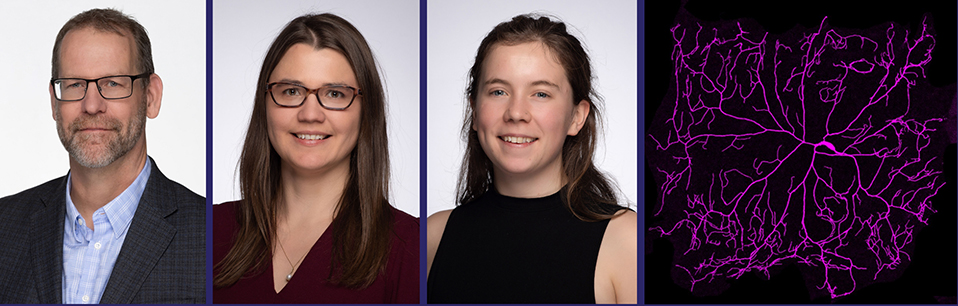
Led by Don van Meyel, PhD, senior scientist in the Brain Research and Integrative Neuroscience program at The Institute, the research team showed how Spire and Rab11 cooperate to shape dendrite architecture. By uncovering how these proteins act together to trigger branch formation, the study provides new insight into how neural circuits develop and adapt.
Seeing neurons build themselves
Using live imaging in insect neurons, the researchers observed the Spire protein gathering at sites where new branches were about to form, triggering a rapid burst of actin filament growth that drives the protrusion of a new dendritic branch. Rab11, a protein that regulates the transport of materials within cells, was also present at these sites, suggesting that its trafficking activity helps deliver components required for branch growth. Together, the two proteins link the neuron's internal transport system with its structural machinery, coordinating the supply of materials and the forces required to build new dendritic branches.
To uncover this mechanism, the team combined genetic, biochemical and imaging approaches. They engineered mutant and fluorescently tagged versions of the Spire protein in Drosophila sensory neurons, allowing them to follow its precise movements during branch formation. High-resolution confocal microscopy captured bursts of actin filament assembly coinciding with Spire's appearance at branch initiation sites. The researchers also demonstrated that each domain of the Spire protein is essential for normal dendritic development, emphasizing how finely tuned its interactions are with Rab11, actin, and perhaps other cellular partners.
"Capturing these events took a lot of patience — and we had to refine our approach again and again," said Deirdre Hatton, M.Sc, co-first author and a graduate student in the van Meyel lab at the time of this work. "Each experiment brought us a little closer until we could finally see the mechanism unfold. It was challenging but deeply satisfying to add a new piece to the larger story of how neurons take shape."
"The changes inside a neuron happen very quickly and subtly — what makes this work so exciting is that we could watch the actin network come alive just as a neuron started to grow a new branch," added Claire Marquilly, PhD, co-first author and a former trainee with Prof. van Meyel. "Seeing how Spire and Rab11 worked in real time helped us connect two systems that usually feel worlds apart — the cell's internal transport and its structural framework."
Advanced imaging at The Institute
This discovery was made possible through the support of The Institute's Molecular Imaging Platform, where advanced microscopy tools and expert technical support enable researchers to visualize living systems at extraordinary resolution. Staff specialists Min Fu, PhD, and Shi Bo Feng, M.Sc., provided the imaging expertise that brought Spire's role into focus. The platform is one of the Technology Platform facilities at The Institute that provide scientists with access to state-of-the-art equipment and expert guidance, accelerating discoveries that advance health research.

Looking ahead
The researchers plan to explore how Spire and Rab11 interact with other proteins that regulate the actin cytoskeleton, and whether similar mechanisms shape dendritic growth in mammalian neurons.
"This work reminds us how much there is still to learn about how neurons build and maintain their connections," said Prof. van Meyel. "Each new piece of the puzzle brings us closer to understanding how the brain develops, adapts and repairs itself."
The research was supported by the Canadian Institutes of Health Research (CIHR), the U.S. National Institutes of Health (to collaborator Margot Quinlan, PhD, University of California, Los Angeles) and studentships from The Institute and McGill University.
About the publication
Hatton D, Marquilly C, Hanrahan C, Ferreira T, Ou Y, Cinq-Mars L, Silkworth W, Bailey HM, Quinlan ME, van Meyel DJ. Nascent dendrite branches initiated by a localized burst of Spire-dependent actin polymerization. Development. 2025 Sep 15. 152(18):dev204786.
DOI: 10.1242/dev.204786
Related news
The unexpected role of chloride channels in a rare neurological disorder
Recovering from sleep deprivation: What is the role of astrocytes?