
New findings show that exposure to arsenic in drinking water may impact the formation of nephrons during embryonic growth and increase the risk of chronic kidney disease
SOURCE: Research Institute of the McGill University Health Centre (The Institute)
August 7, 2025
According to the World Health Organization (WHO), millions of people worldwide are exposed to arsenic levels in drinking water that exceed the WHO provisional guideline of 10 μg/L (10 parts per billion).
A recent study led by Indra Gupta, MD, with a team at the Research Institute of the McGill University Health Centre (The Institute) reveals how exposure to arsenic during pregnancy—even at moderately elevated levels—can interfere with kidney development in the embryo. The research, published in Toxicology and Applied Pharmacology, demonstrates that arsenic may reduce the formation of nephrons, the kidney's essential functional units, during embryonic growth.
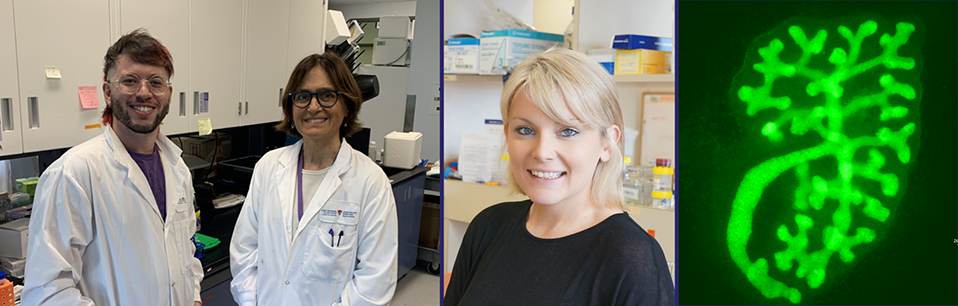
"Our findings suggest that prenatal arsenic exposure, even at moderate concentrations, may impair kidney development and increase the risk of chronic kidney disease," said Dr. Gupta, who is a Senior Scientist in the Child Health and Human Development Program and Deputy Director at The Institute.
To investigate how arsenic exposure affects developing kidneys, the researchers used a complementary mix of experimental approaches. They began with lab-grown embryonic kidney tissues, which allowed them to observe how cells respond to arsenic in real time.
The next step was to study mouse models. "Normal mice metabolize arsenic very efficiently," said Jenna Haverfield, PhD, Scientific Research Manager at The Institute and co-first author of the publication. "As we expected, very little kidney damage was seen in embryos of standard lab mice exposed to drinking water with moderate levels of arsenic."
"The story changed when we used 'humanized' mice," said Carlos Agustin Isidro Alonso, PhD, a Research Associate in Dr. Gupta's lab at The Institute and co-first author of the publication. "Humanized mice are genetically modified to process arsenic the same way humans do — which is much less efficiently than normal mice. In this case, prenatal arsenic exposure led to smaller kidneys and a sharp drop in the number of nephrons, which are the tiny filtration units that determine kidney function for life."
This reduction was traced back to disruptions in a key early developmental process known as ureteric bud branching, which helps shape the structure of the kidney.
The exposure to moderate levels of arsenic caused increased cell death in kidney progenitor cells and interfered with signals needed for growth, including a gene called GDNF, which plays a central role in kidney formation.
"Given the implications for human fetal development, and because millions of Canadians and people around the world are exposed to arsenic through water, food and air, we hope to raise awareness of exposure risks during pregnancy," said Dr. Gupta.
This study was part of the DERIVE (Developmental Research on Interactions between Variants and the Environment) research program, which is funded by an anonymous donor through the Montreal Children's Hospital Foundation.
The team worked with the technology platforms at The Institute, including the Molecular Imaging Platform for confocal images and the Histopathology Platform for tissue processing.
The publication "Mouse nephron formation is impaired by moderate dose arsenical exposure" was authored by Carlos Agustin Isidro Alonso*, Jenna Haverfield*, Gabriela Regalado, Sihem Sellami, Natascha Gagnon, Ajay Rajaram, Pierre Olivier Fiset, Tomoko Takano, Aimee K. Ryan, Koren K. Mann, and Indra R. Gupta, and published in Toxicology and Applied Pharmacology, Volume 500, 2025. (*Co-first authors)
DOI: https://doi.org/10.1016/j.taap.2025.117355.
Related news
Research seeks to help children with chronic kidney disease
RI-MUHC researcher has a new global role to play, on and beyond World Kidney Day