
The annual event brought the community together to celebrate research excellence and reflect on strategic momentum and the continued rollout of the Institute's 2030 Vision
SOURCE: The Institute
December 19, 2025
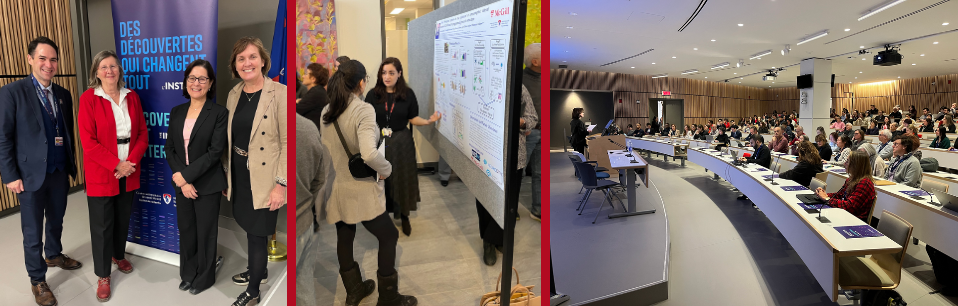
At the annual 2025 Research Day of the Research Institute of the McGill University Health Centre (The Institute), held on Friday, December 12, members of The Institute community gathered to celebrate the exceptional research carried out over the past year and to reflect on progress toward the Institute's long-term strategic goals.
The event highlighted both scientific excellence and the deepening impact of The Institute's 2030 Vision, an ambitious strategic plan launched in 2024 under the leadership of Dr. Rhian Touyz, Executive Director and Chief Scientific Officer of The Institute. One year into its implementation, the plan's focus on advancing precision health throughout the life course, strengthening research excellence, fostering collaboration and embedding equity and innovation was evident throughout the day's programming.
Strategic vision and leadership reflections
In her opening remarks, Dr. Touyz reflected on key milestones of the past year and reiterated The Institute's commitment to translating long-term strategy into action. She was joined by leadership from The Institute and the MUHC, reinforcing the shared institutional focus on research that drives both scientific discovery and patient impact.
Building on this theme, Pierre-Albert Coubat, Chief Operating Officer at The Institute, spoke about the importance of institutional alignment in enabling world-class research. He highlighted the need for strong bridges between research, operations and clinical environments — essential elements in creating the structures that support collaboration, efficiency and shared purpose across the organization.
Dr. Touyz was followed by an inspiring keynote from Dr. Victor Dzau, President of the U.S. National Academy of Medicine (NAM) and Chair of The Institute's External Scientific Advisory Board (ESAB). Dr. Dzau's lecture, entitled "Future of Biomedical Research and Academic Medicine: Preparing for Changing Times," underscored the importance of bold, collaborative research strategies in tackling complex health challenges — themes that closely align with the ambitions of the 2030 Vision and resonated strongly with the audience.
Showcasing research networks and innovation
Research Day also provided a platform to showcase the depth and diversity of research underway across The Institute. Presentations from each of the three Research Networks demonstrated how investigators are driving innovation across a range of disciplines:
Geneviève Bernard, MD, M.Sc. – CARELeuko: Canadian Association for Research Excellence in Leukodystrophy (presented by trainee Roberta La Piana, MD, PhD)
Julia Burnier, PhD – Circulating Biomarkers of Health and Disease (liquid biopsy and cfDNA) (presented by research associate Kyle Dickinson, PhD)
Stella Daskalopoulou, MD, M.Sc., PhD – Hypertension and Vascular Diseases Network
These sessions highlighted both the collaborative strength and the translational potential of network-based research at The Institute.
Clinical Observerships: Bridging bench and bedside
A special segment of the program featured the Clinical Observership Program, a new initiative that deepens the connection between laboratory science and clinical realities by placing postdoctoral trainees alongside clinical mentors and healthcare teams. This pilot edition of the program featured four exceptional scientists whose work spans a range of biomedical disciplines, three of whom were present to share their experiences:
Sabrina Alam, PhD, studying POLR3-related leukodystrophy, gained firsthand insight into clinical care for rare white matter diseases under the mentorship of Dr. Geneviève Bernard.
Vanessa Hadid, PhD, whose research focuses on cochlear implant outcomes, observed key stages of the implantation process with Emily Kay-Rivest, MD, M.Sc., enriching her understanding of patient experiences.
Justine Mathé, PhD, who studies host–pathogen interactions in cystic fibrosis, shadowed pediatric respirologist Larry Lands, MD, PhD, gaining perspective on the clinical dimensions of chronic lung disease.
Xiaoyi (Michelle) Lan, PhD, working on biomaterials for disc repair, connected her engineering research to clinical practice with mentor Dr. James Wu.
Their participation at Research Day highlighted how direct exposure to clinical environments can enrich scientific inquiry and help shape research questions grounded in patient needs.
Trainee posters and recognition
The poster session featured trainees from across The Institute, offering attendees a chance to engage with cutting-edge research spanning basic, translational and clinical domains. Three trainees were recognized for outstanding presentations, highlighting the strength of the next generation of researchers committed to advancing The Institute's mission:
Best Poster (BSc/MSc Category)
The Role of TMED2 in Murine Cardiac Development — Amanda Teixeira (Supervisor: Loydie Jerome-Majewska, PhD)
Best Poster (PhD Category)
Dual Nature Hybrid Cells and the Tumor Microenvironment as Potential Drivers of Uveal Melanoma Metastasis — Emily Marcotte (Supervisor: Miguel Burnier, MD, M.Sc., PhD)
Best Poster (Postdoctoral Fellow/MD/DMD Category)
Dual-Peptide Functionalized Alginate Hydrogels Mimic Nucleus Pulposus Microenvironment to Support Nucleus Pulposus Cell Attachment and Phenotype — Khatra Badreldin (Supervisor: Lisbet Haglund, PhD)
Advancing strategy and research support
Research Day also featured reflections on the strategic and operational foundations that support the Institute's research mission. Necola Guerrina, from the Research Strategy Office, spoke first, outlining how the office is helping drive the next phase of the 2030 Vision, with an emphasis on coordinated planning, institutional alignment and sustaining momentum as the strategy continues to move from vision to action. This was followed by remarks from Benoît Chambaron, of the Pre-Awards and Business Development Office, who reflected on The Institute's 2025 achievements and outlined exciting goals for 2026, highlighting continued efforts to strengthen support for investigators and foster research growth across the organization.
Looking ahead
As the 2025 Research Day drew to a close, attendees left with a renewed sense of purpose and momentum — celebrating a year of progress and looking forward to the innovations and collaborations that 2026 will bring. The day reaffirmed The Institute's role as a hub of discovery and impact, anchored in excellence and guided by a vision that places precision health at the core of its mission.
In her closing remarks, Dr. Sarah Prichard, Chair of the Board of Directors of The Institute, acknowledged the community's achievements and reaffirmed strong support from The Institute's Board of Directors for The Institute's strategic direction and its continued commitment to research excellence.
Related news
A transformative journey to advance precision health throughout the life course
The Institute's Clinical Observership Program: Bridging lab research and patient care