
From learning to action: How the MISI Summer School helped trainees strengthen inclusive research practices
At the 2026 MISI Summer School, 16 trainees moved from discussing inclusive research to testing how it could change their own studies.
Source: The Institute
September 8, 2026
Sixteen trainees from The Institute brought their own questions, experiences and research projects to the 2026 Integral Mentorship for Inclusive Science (MISI) Summer School. By the end of the four-day program, they identified new ways to make their research more inclusive, equitable and responsive to the communities they hope to serve.
To get there, trainees looked closely at research already underway. They mapped the people affected by their work, explored potential sources of exclusion and considered who might be missing from key stages of the research process. The goal was not to add inclusion after the fact, but to examine how it could strengthen research decisions from the outset.
The 2026 cohort included recipients of The Institute's Equity Diversity and Inclusion (EDI) Awards for Academic Excellence: Alireza Roosta, Ayla Gerk Rangel, Devin Fraser, Faezeh Lotfi Kazemi, Kyeong Beom Jo, Phoenix Plessas-Azurduy, Vidhi Desai, Dunya Moghul, Eileen Oh, Kalpana Chaudhary, Moustafa Laymouna, Odette Rios Ibacache, Mackenzie Rachel Fredericks and Seong Yeon Kim, as well as two Indigenous MISI Prize recipients Tehya Armstrong and Jason Paeiro.
The EDI awards for Academic Excellence recognize masters and doctoral trainees that are members of equity-seeking groups for their academic excellence, reflection on systemic barriers and potential to advance medical and health research. The awards are supported by the MUHC Foundation, the Montreal Children's Hospital Foundation and the Montreal General Hospital Foundation. The MISI Prizes create paid research and mentorship opportunities for Indigenous undergraduate students through the MISI project supported by the NovaScience of the Québec Ministry of the Economy, Innovation and Energy.
Learning from multiple forms of expertise
Throughout the week, trainees participated in panels, workshops and community-led sessions on ethical and community-grounded research, Indigenous cultural safety, intersectionality, patient partnership and knowledge mobilization. They learned from Indigenous researchers and health leaders Alex McComber, Samantha Coonishish, Christina Smith, Kahá:wi Jacobs; from researchers and practitioners including Dr. Sahar Fazeli, Dr. Hannah Quinn, Fatoumata Baldé, Seeta Ramdass, Sarah Mohamed and Dr. Argerie Tsimicalis; and from patient partners Linda Hunter and Khadidja Chougui.
Across these sessions, speakers challenged trainees to treat community priorities, cultural safety and lived experience as sources of expertise transversal to their methodologies, analysis and knowledge translation strategies.
Turning inclusion principles into a practical method
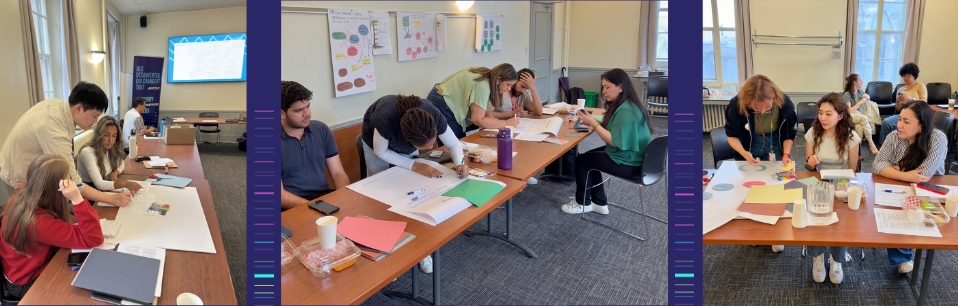
The Institute's Desjardins Centre for Advanced Training (DCAT) and Equity, Diversity and Inclusion (EDI) teams designed the Summer School to move beyond discussion. With this purpose, the MISI Summer School paired presentations and panels with six practical sessions (hands-on workshops). In these sessions, trainees created interdisciplinary groups, discussed shared challenges, and questioned familiar research practices. In groups, they examined how inclusive approaches could reshape research questions, methodologies, participant patients, or analytical strategies. Trainees first mapped the research actors connected to their work toanalyze power relations among these actors.
Each team then used the Five Whys, a root-cause analysis method, to move beyond the immediate signs of inequity and trace them back to underlying inequity causes and structures. With those root causes identified, trainees returned to their research actor maps and applied an intersectional lens. They considered how identities, lived experience, and social context shape different actors' healthcare-related needs, barriers and opportunities.
Drawing on this analysis, trainees redesigned their research methods to better include the communities they intend to serve. At every stage of the research design, trainees were encouraged to ask who was included, who was missing and whose perspectives might be overlooked. These questions helped them challenge assumptions and identify ways to make their projects more equitable, accountable and scientifically rigorous.
Learning through collaboration
The interdisciplinary character of practical sessions created a setting in which trainees could learn from one another's experiences and expertise field to recognize unseen areas in their own projects.
For one trainee, the practical sessions created an especially valuable space for collaborative learning: "I refined my understanding of why diversity is important in research. I understood where I fit among other research and healthcare professionals, and I was able to connect with talented researchers who I think will be great allies."
These exchanges gave trainees language and tools to recognize gaps in their work. The next step was to translate analysis into changes to their projects' methodologies. In the subsequent sessions, trainees questioned their research methods and proposed modifications to be more inclusive of the communities their work intends to serve. One group that initially focused on providing information to children with inflammatory bowel disease (IBD) recognized that the needs of Indigenous and other diverse communities were not adequately reflected in the project's original design. In response, they proposed creating culturally safe resources and refining them in partnership with community members to ensure they remain relevant and useful.
Another team proposed modifications to a clinical trial involving infants born preterm who receive postnatal steroids to support lung development. To ensure representation of the broader Montreal population, they suggested expanding the trial beyond the Montreal Children's Hospital to additional centers, including those serving rural and Indigenous communities. This could improve the representation of different populations in this trial. The trainee also recommended developing more inclusive informed-consent practices for Indigenous families. This recommendation involves a culturally safe approach to informed consent shaped in partnership with Indigenous communities and access to interpretation in the family's preferred language.
At the end of the Summer School, trainees presented the gaps they had identified, why those gaps mattered and how their proposed inclusion methods could strengthen both scientific relevance and accountability to participating communities.
By working through real projects, they moved from discussing inclusion as a broad principle to identifying specific ways to build it into research decisions.
As one participant explained: "The Summer School helped me develop insights into intersectionality and participatory research. I learned to be mindful of cultural safety when designing studies and created a roadmap for conducting ethical and participatory research with Indigenous communities."
The MISI Summer School helped trainees turn these principles into concrete changes within their own projects. As they advance in their careers, they will carry forward new ways of asking research questions, recognizing different forms of expertise, building equitable partnerships, and sharing knowledge. In doing so, they can help shape a health research ecosystem in which inclusion is not an addition to scientific excellence, but an essential part of science better adapted to the needs of communities.
The Integral Mentorship for Inclusive Science (MISI) project is supported by the NovaScience Program of Québec's Ministry of Economy, Innovation and Energy.