
Shirin Abbasinejad Enger and Vincent Giguère receive 2025 Awards for Excellence, recognizing a career of barrier-breaking advocacy and four decades of transformative scientific discovery
SOURCE: Canadian Cancer Society / The Institute
July 2, 2026
The Research Institute of the McGill University Health Centre (The Institute) is proud to congratulate two of its researchers on receiving 2025 Canadian Cancer Society (CCS) Awards for Excellence — one of the most prestigious forms of recognition in Canadian cancer research. Now in its 32nd year, the CCS Awards for Excellence honour individuals who have made outstanding contributions to cancer research and cancer control in Canada.
This year, Shirin Abbasinejad Enger, PhD, receives the Inclusive Excellence Prize, and Vincent Giguère, PhD, receives the Robert L. Noble Prize.
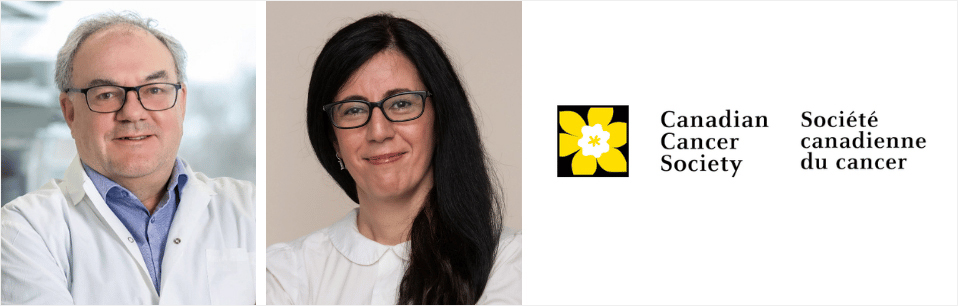
Shirin Abbasinejad Enger, PhD
Recipient, 2025 Inclusive Excellence Prize
Associate Investigator, Cancer Research Program, The Institute
Full Professor and Director, Medical Physics Unit, Gerald Bronfman Department of Oncology, McGill University
Canada Research Chair in Medical Physics
“Dr. Enger’s career trajectory is a testament to resilience and excellence,” says Dr. Eduardo Franco, a cancer epidemiologist at McGill University who nominated Dr. Shirin Abbasinejad Enger for the 2025 Inclusive Excellence Prize. “As the first woman to lead McGill’s Medical Physics Unit and Graduate Program, she has shattered glass ceilings and created pathways for others to follow.”
Dr. Enger’s story is one of overcoming obstacles – from her early days as a Kurdish refugee to becoming a global leader in medical physics and a champion for inclusive representation in cancer research.
While still a student, she realized that her lectures and textbooks contained few stories of women in science. “This absence did not embitter her; it galvanized her,” says Yujing Zou, a PhD candidate currently studying under Dr. Enger. “Rather than accepting a system that failed to see her, she devoted her career to building a system where others would be seen.”
Now, Dr. Enger mentors over 30 trainees at every level from undergraduate to postdoctoral. Her lab welcomes people from groups that are historically underrepresented in physics, engineering and computer science. Students not only appear as first authors on papers but also attend conferences and develop independence and leadership skills to prepare them for successful science careers.
Dr. Enger’s impact extends beyond the students and trainees in her lab. She is deeply committed to expanding access to education and training in artificial intelligence (AI), medical imaging and health. Through her lab, she has supported McMedHacks, a free international summer program that introduces students, researchers and clinicians to medical image analysis and deep learning. She also helped support the launch of SPARK (Sprint AI Training for African Medical Imaging Knowledge Translation), an initiative led by Dr. Udunna Anazodo. Together with her graduate students and postdoctoral fellows, Dr. Enger contributed to this train-the-trainer program, which aims to empower research leaders across Africa to teach and advance AI for medical imaging and cancer-related applications.
Her commitment to accessibility is also reflected in her own medical physics research, where her team develops advanced tools and technologies that can be shared, adapted and built upon by the broader research community.
“Dr. Enger is an extraordinary scientist and a tireless advocate for equity, diversity, and inclusion in cancer research,” says Dr. Franco. “Her leadership, mentorship, and unwavering commitment to advancing opportunities for women and underrepresented groups in science exemplify the very essence of this prestigious award.”
Vincent Giguère, PhD
Recipient, 2025 Robert L. Noble Prize
Associate Investigator, Cancer Research Program, The Institute
Professor, Faculty of Medicine, Goodman Cancer Institute, McGill University
Dr. Vincent Giguère is an internationally recognized leader in cancer science. He has spent over four decades making pioneering discoveries about how cancer sends and receives signals in the body. His work has led to not only new scientific techniques for studying cancer, but also new tests and treatments that are now part of standard care.
“Dr. Giguère’s career embodies the highest ideals of scientific excellence, innovation, and impact,” says cancer epidemiologist Dr. Eduardo Franco, who nominated him for the 2025 Robert L. Noble Prize. “His discoveries have reshaped cancer biology, informed clinical practice, and inspired generations of scientists.”
The Robert L. Noble Prize is awarded to a researcher who has made outstanding achievements in biomedical cancer research. Dr. Giguère’s influence on cancer research has been – and continues to be – revolutionary.
Early in his career, Dr. Giguère discovered a gene called retinoic acid receptor alpha (RARA), which guides cells to mature in the presence of vitamin A. This gene is mutated in a type of cancer called acute promyelocytic leukemia (APL). Knowing about RARA meant researchers could diagnose APL more easily and opened up new possibilities for treatment – turning it from a fatal disease into one of the most curable forms of leukemia.
Since then, Dr. Giguère has studied many other genes that control how cells develop and, in some cases, become cancerous. He has also developed a type of lab test called the co-transfection assay, which has been adopted worldwide and has helped researchers identify chemicals to become new cancer drugs.
“I consider Dr. Giguère to be among the most creative and productive scientists in our field, with a career spanning 40 years that has been highlighted by many outstanding discoveries,” says Dr. Donald P. McDonnell, a molecular cancer biologist at Duke University who supported the nomination. “He is a pillar of the cancer research community in Canada and internationally who has dedicated his career to advancing basic cancer research and whose numerous discoveries have had tremendous impact in oncology.”
A shared commitment to advancing cancer science
Together, Dr. Enger and Dr. Giguère represent the breadth of what cancer research at The Institute looks like: from the fundamental molecular science that yields new treatments, to the training ecosystems that ensure the next generation of researchers reflects the full diversity of those whose lives cancer touches. The Institute congratulates them both on this well-deserved recognition.