
Two teams showcased Canadian health innovations at a national science fair for MPs, senators, and federal ministers
Source: The Institute
June 17, 2026
Last month, researchers from the Research Institute of the McGill University Health Centre (The Institute) joined a select group of Canadian health innovators on Parliament Hill for Made-in-Canada Solutions for Global Health Security, a Parliamentary Science Fair hosted in Ottawa's Valour Building.
Organized by Results Canada, the event brought together global health initiatives, civil society organizations, and private sector partners to show parliamentarians, including Members of Parliament, senators, and ministers, the tangible results of Canada's investments in health innovation, research and development. The evening drew 23 MPs and the Honourable Randeep Sarai, Secretary of State for International Development, who delivered remarks and spent time with the exhibiting researchers.
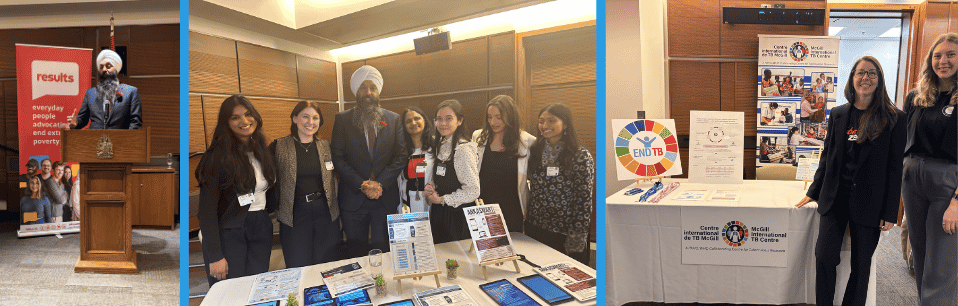
The Institute had a presence in two of the event's seven themed booths — one of a handful of institutions represented across multiple thematic areas.
Fighting tuberculosis with a smarter clinical trial
At the Therapeutics booth, the McGill International TB Centre (MITBC) shared the stage with the TB Alliance, a US-based not-for-profit leading global efforts to develop faster, simpler, and more effective cures for all forms of tuberculosis. Together, they spotlighted advances in new drug regimens to prevent tuberculosis (TB) and the SSTARLET trial — Shorter and Safer TreAtment Regimens for LatEnt TB — a CIHR-funded adaptive Phase 2 clinical trial led by principal investigator Dick Menzies, MD, a senior scientist in the Translational Research in Respiratory Diseases Program at The Institute and professor at McGill University.
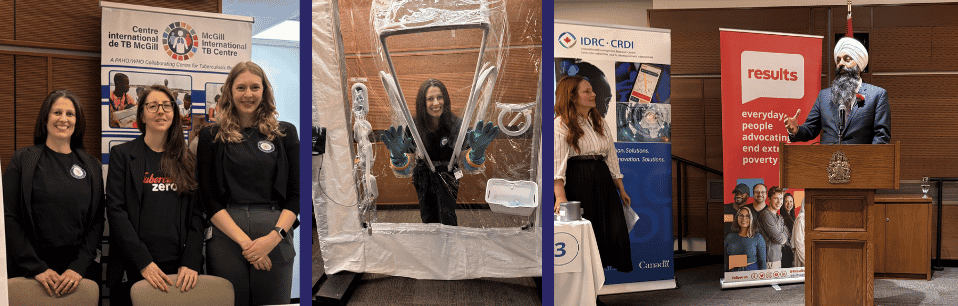
SSTARLET directly compares the safety, tolerability, acceptability, cost, and drug exposure of novel TB preventive treatment regimens against a standard comparator, with the shortest and safest candidates moving forward to Phase 3 trials using the same adaptive platform.
"Tuberculosis is preventable, and SSTARLET is helping us find the best way to do that — faster, safer, and for people in Canada and around the world," says Olivia Oxlade, PhD, Associate Director of the MITBC, who represented the Centre at the event. "Bringing this work to Parliament Hill is a reminder that the research happening in our clinical trials has real consequences for real people."
The study is currently enrolling adults and children with TB infection in seven Canadian cities — Calgary, Edmonton, Vancouver, Winnipeg, Ottawa, Toronto, and Montréal — as well as international sites in Indonesia, Vietnam, and Brazil. It also draws on a Community Advisory Board of TB-affected individuals from across Canada.
Digital innovations to advance sexual and reproductive health, from Montréal to the world
At the Diagnostics booth, Nitika Pant Pai, MD, PhD, a senior scientist in the Infectious Diseases and Immunity in Global Health (IDIGH) Program and professor at McGill University, presented the portfolio of digital and AI-enabled tools developed by her Smart Unlearning Labs team at The Institute and McGill. With ten patented programs targeting sexually transmitted infections and sexual and reproductive health — five of which are market-ready and supported by key Canadian and international agencies — the lab has built a reputation for marrying innovation with rigorous implementation science that generates health and social impact. Student researchers and trainees Ashlyn Beecroft, Luciana Escobar, Vidhi Desai, Anya Ganesh, and Melisa Eraslan were also among those representing the lab at the event.

These five programs are in various stages of development and scale-up, supported by funders including CIHR, the FRQS, and Grand Challenges Canada, and have been announced for adoption by international health agencies. The work has been referenced in national and international policy guidance and showcased at venues including the National Academy of Sciences in the United States and global health forums in Geneva.
Secretary Sarai engaged with the programs and their potential to improve screening, detection, and linkage to care for populations affected by STIs, both in Canada and internationally.
"Our digital innovations were built to close health service delivery gaps — by providing access to care, improving timely detection of infections, and initiating linkages and retention in care — for people who are some of the hardest to reach in the world," says Dr. Nitika Pant Pai. "To have that work recognized at the federal level, by the people who shape health policy and funding, is incredibly meaningful for our lab and our entire team and for The Institute and University we represent."
Related news
The future of HIV diagnostics: an exemplar in infectious diseases